Current Situation for Democracy and Human Rights Defenders Around the World : Professor Miriam Cohen appears as an expert witness before the Subcommittee on International Human Rights of the Standing Committee on Foreign Affairs and International Development
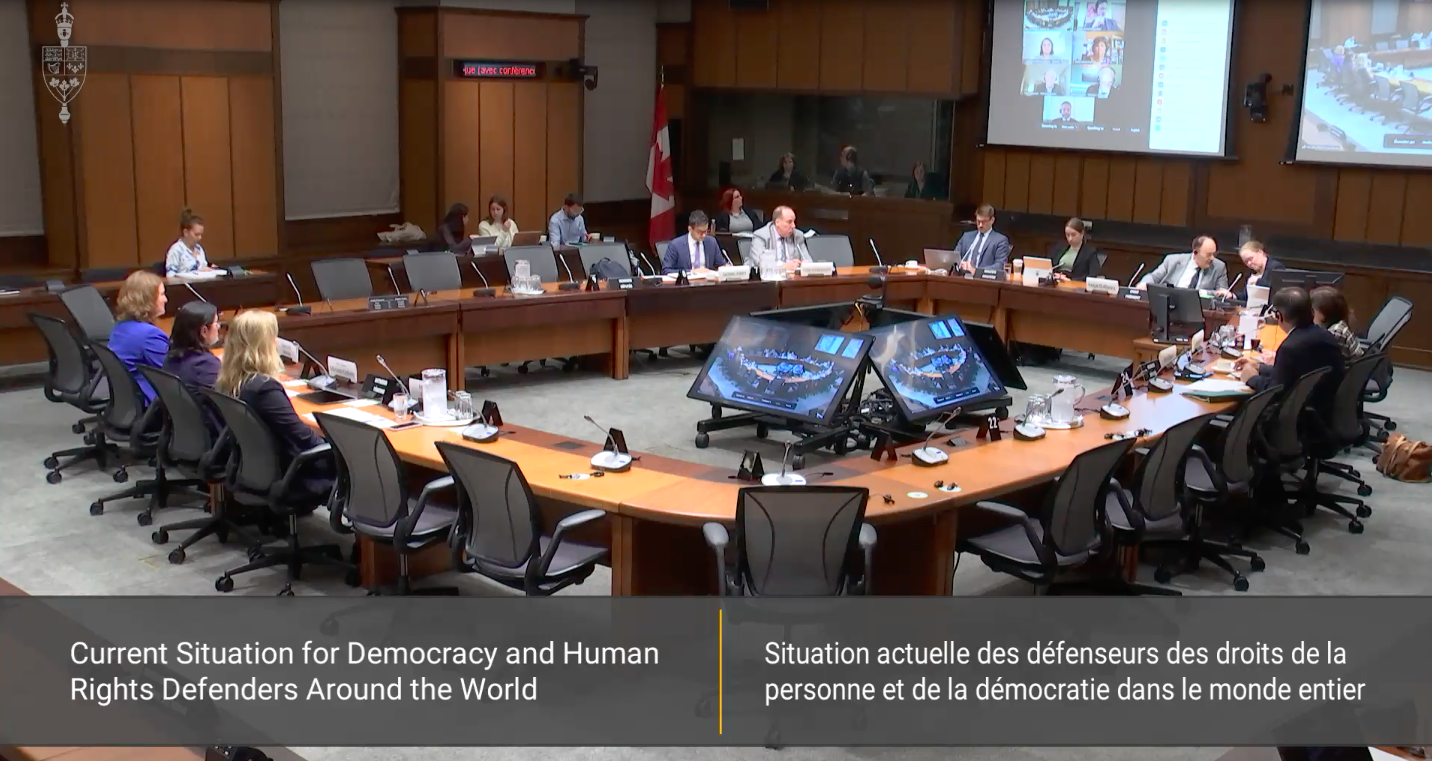
Professor Miriam Cohen appeared on 13 April as an expert witness before the Subcommittee on International Human Rights of the Standing Committee on Foreign Affairs and International Development as part of an inquiry into the "Current Situation for Democracy and Human Rights Defenders Around the World".
This study aims to analyse several major issues, including the state of global human rights networks, pro-democracy movements, and international mechanisms for funding and protecting democracy and human rights defenders.
In her presentation, Professor Cohen shed light on the legal and institutional frameworks that shape international responses to threats to democratic governance and fundamental rights, as well as on the current situation of human rights defenders.
Her speech can be viewed here
Below is a transcript of his speech
"Mr. Chair and members of the committee, my name is Miriam Cohen, and I am the Canada research chair in human rights and international reparative justice at Université de Montréal.
Thank you very much for inviting me to be here today and for considering the situation of democracy and human rights defenders around the world. It's an honour to contribute to the committee's work on an issue that directly concerns the rule of law, democratic governance and the protection of fundamental freedoms.
My remarks will focus on three areas. First, I'll provide an overview of the current situation of human rights defenders internationally. Then, I'll discuss legal frameworks and institutional mechanisms for protection, and I'll end with some best practices and recommendations.
Human rights defenders play an essential role in any democracy. They help to ensure that human rights are protected and respected, and that democratic principles are upheld. Human rights defenders come from a wide variety of backgrounds. They are youth, adults, members of indigenous communities, recognized professionals and civil society actors. Active in both urban and remote areas, detention settings, and conflict and post-conflict zones, they work alongside refugees, migrants and asylum seekers. They are also present in new arenas such as climate change, AI and emerging technology.
Despite the crucial role they play, human rights defenders are routine targets for intimidation, attack, abduction, false accusations and serious rights violations, by both state and non-state actors. They are unfairly tried, wrongfully convicted and sometimes murdered or forced into hiding.
These trends fit into a broader context of democratic backsliding. Global indicators show that civil and political liberties have been consistently deteriorating for over a decade. When democratic institutions are weakened, human rights defenders often become targets, precisely because they serve as a counterbalance.
Today, various legal mechanisms and instruments help to protect human rights defenders.
In 1999, the UN General Assembly adopted the Declaration on Human Rights Defenders, recognizing their role and their right to promote and protect human rights. Although not legally binding internationally, the declaration is based on the Charter of the United Nations and the major international treaties on human rights. In addition, the UN Human Rights Council examines matters related to the protection of human rights defenders through its universal periodic review and special procedures. The special rapporteur on the situation of human rights defenders plays an essential role, analyzing information on violations and developing recommendations.
A number of regional initiatives complement these frameworks.
In Europe, the Council of Europe adopted a declaration to improve the protection of human rights defenders and has a general rapporteur responsible for monitoring the situation of human rights defenders.
In Africa, the African Commission on Human and Peoples' Rights created a special rapporteur on human rights defenders mandated to pay particular attention to certain types of vulnerable people, including women's rights defenders and environmental advocates.
It is also important to point out that states can neither delegate their responsibility to protect human rights defenders nor use exceptional circumstances to shirk their responsibility. The protection of human rights defenders stems from a fundamental obligation under the rule of law. Human rights defenders are vital to the workings of a democratic society. Their work helps to prevent rights abuses, strengthen public trust and support the rule of law. For that reason, their protection is imperative to democracy.
With that in mind, it is especially important for the international community to prioritize three things.
The first is to fight against impunity for perpetrators of violence against human rights defenders.
The second is to guarantee freedom of association and access to funding for civil society.
The third is to ensure clear and consistent political support for democracy and human rights defenders at risk".
This content has been updated on 7 mai 2026 at 17 h 43 min.
Comments